
Fraud, Fakes & AI: The New Corporate Battleground

Fraud, Fakes & AI: The New Corporate Battleground

The firm had an illustrious history and a sophisticated executive team. But its profits made it a prime target, and last year, a victim of a new-age crime worth some attention.

The company, Arup, based in the United Kingdom, was founded nearly 80 years ago. It employs more than 18,000 employees in 140 countries to design buildings, bridges, electrical facilities, and water treatment plants, among other major projects, including the Sydney Opera House, the Oresund Bridge connecting Sweden and Denmark, and Beijing’s 2008 Olympics’ Bird Nest Stadium. It generated revenue of more than $2.7 billion in 2023, with nearly $70 million in profits.

Earlier this year, however, one of their Hong Kong employees was duped by virtual fraudsters who utilized the newest tools in Artificial Intelligence (AI) to create a deepfake video that impersonated the company’s Chief Financial Officer (CFO) and other corporate employees to orchestrate the digital transfer of more than $25 million to a cyber thief.

In this case, according to press reports, the Arup employee initially received an email – supposedly from the company’s UK headquarters office — about quietly setting up the financial transactions. To his credit, the employee initially suspected a phishing attempt. However, the thief or thieves were able to assuage those fears by setting up an AI-generated deepfake video conference call between the Hong Kong-based employee and the company’s CFO and other senior corporate staff known to the employee.

The conversation and images on the video call looked authentic to the worker in the company’s finance department in Hong Kong. In fact, he was the only actual person on the call. The others were all fake, AI-generated videos of real colleagues. This was part of an elaborate AI-fueled scam.

Subsequently, at the direction of the AI-generated CFO, the worker made fifteen separate financial transactions wiring a total of $25 million  to five distinct Hong Kong bank accounts, according to news reports. At the end of these transactions the worker finally made an inquiry about the transactions with the company’s headquarters in the United Kingdom and realized he had made an expensive mistake.

Hong Kong police told reporters they have had at least 20 similar AI-deepfake incidents reported to them, which resulted in 90 fraudulent loan applications and 54 bank account registrations between July and September 2023. Six people have apparently been arrested tied to those incidents, but it is unclear if they were also connected to the Arup case.

In May 2024, Warren Buffet warned that AI-related scams may become the “growth industry of all time.” Fast Company and CNBC reported on Buffet’s comments, and a video-link to Buffet’s remarks showed him relaying an incident that happened to him. He was sent a recent image of himself, wearing his clothes, replicating his own voice, that was generated by AI, and he joked that the representation was so good that it could have fooled him into wiring money to himself.

Although there is growing investment in AI-powered tools meant to identify and prevent fraud, sophisticated AI-related scams are occurring on an increasing basis. Corporate fraud is an old threat, but artificial intelligence is creating new, expanding, and evolving challenges making it more difficult to both identify and prevent AI-related scams from deceiving a wide-range of employees and corporate executives alike.

Like so many technologies, AI has become a double-edged sword, requiring that corporations take extra care in vetting transactions and partners. On the positive side, it has ushered in an era of great promise in medical research, national security, science, economic efficiencies, education, and other fields. In February 2023, for instance, Mark Read, the Chief Executive Officer (CEO) of the world’s largest marketing company, WPP, told The Guardian newspaper that over the past few years the company had been investing in AI-advertising, generating AI-inspired videos, and that this was both helping the company “win new business” and that this sort of AI-advertising was “fundamental” to the company’s future success.

However, AI has also unleased serious new perils in the corporate and financial arenas. One year after Read’s comments, YouTube footage and a voice clone of Read were used in a Microsoft Teams meeting with another senior WPP executive in an ill-fated attempt to solicit money and personal information by urging him to set up a new business. “Fortunately the attackers were not successful,” Read wrote in an email divulging the AI-inspired scam. “We all need to be vigilant to the techniques that go beyond emails to take advantage of virtual meetings, AI and deepfakes,” he wrote.

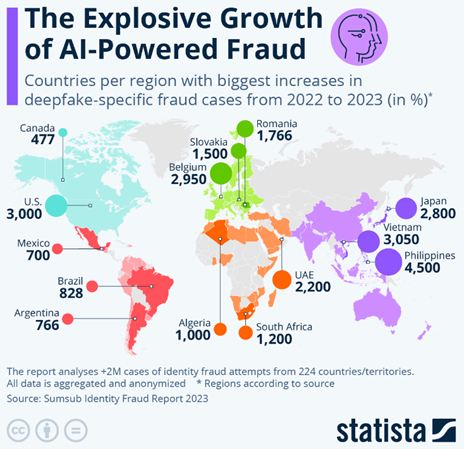
Last year, the World Economic Forum noted the increasing use of AI in cybercrimes, especially the use of deepfakes. It said that in 2022/2023, “26% of smaller and 38% of large companies experienced deepfake fraud resulting in losses of up to $480,000.” Indeed, the number of AI-fraud cases continues to expand worldwide as indicated by the chart below:


A recent study of 2,000 American adults found that nearly half (48%) of them believed the increased use of AI in fraudulent activities made them less likely to detect these scams, and more than two-thirds of them believe that AI has had a large impact on financial-related scams. A separate survey conducted earlier this year by the consulting firm KPMG found that 95% of Canadian businesses that had previously experienced fraud, expressed grave concerns regarding the increased abuse of AI-fraud related activities against their companies.

These are not idle fears.

  • In June 2024, the Digital Trust Index, which looks at AI-related fraud, found that “76% of fraud and risk professionals believe their business has been targeted by AI fraud, with over half reporting this type of fraud happening daily or weekly.”
  • In their July/August 2024 issue, Fraud magazine had a featured article on the increasing use of deepfake technology to commit financial crimes. In June The Banker magazine had a similar article focused on the use of deepfakes against banks.
  • In May 2024, the Journal of Accountancy warned Certified Public Accountants (CPAs) about emerging AI threats. “Resourceful fraudsters can now use AI to create convincingly realistic documents and data such as invoices, contracts, reports, spreadsheets, and bank statements to support a fraud scheme,” the article said.
  • In March 2024, INTERPOL released a global financial fraud assessment that highlighted the fact that fraudulent criminal acts are now being conducted by organized criminal networks boosted by technology, including AI. The com website has said that “the average cost of creating a deepfake is $1.33” while “the expected global cost of deepfake fraud in 2024 is $1 trillion.”
  • Last year, the financial auditing and consulting firm Deloitte said the first AI-related fraud case was verified in 2019 in the United Kingdom and resulted in payments of nearly $250,000 to a fictitious company in Hungary. Since then, a global survey has indicated that 37% of organizations have experienced some type of AI-fraud utilizing deepfake voice cloning technology.
  • The financial firm Vanguard also reported last year that a government official in Fuzhou, China, fell victim to AI-related fraud when he mistakenly made a payment of around $600,000 to an individual he believed to be a close friend but in reality was an AI-generated imposter.

Last year, the Federal Trade Commission (FTC) issued an alert regarding the mischievous use of voice cloning technology to engage in illegal acts, and the Consumer Financial Protection Bureau (CFPB) has also warned consumers about AI-inspired fraud that rely upon audio, video, and images to target individuals. The Financial Industry Regulatory Authority (FINRA) and Securities and Exchange Commission (SEC) have also issued warnings about the growing use of AI-enabled fraudulent schemes.

Law enforcement officials have taken note: Earlier this year, Deputy Attorney Geneal Lisa Monaco delivered a speech to the American Bar Association’s National Institute on White Collar Crime and said, “Where AI is deliberately misused to make a white-collar crime significantly more serious, our prosecutors will be seeking stiffer sentences — for individual and corporate defendants alike.”

However, regardless of the government’s actions on these various fronts, the best defense to block AI-fueled fraud schemes is to  make heightened efforts to verify and validate the credibility and authenticity of companies and individuals – as well as their data – of all those that corporations partner with during their regular course of business..

Some protective steps can be taken internally, but others will likely require external assistance.
In any conversations involving transactions or the transfer of sensitive information, employees should:

  • Verify the authenticity of those they are communicating with over the phone, computer, cell phone, or video conference. When in doubt, they should pause, step back, hang up, and initiate the call or communication to the known phone number of the individual who reached out.
  • Validate the accuracy of the information that you are being given in business transactions, particularly with new corporate partners or new senior hires. Validate the source of key information, including business, financial or other records. Evolving protocols for Know Your Customer (KYC) procedures can help verify and validate corporate clients and collaborators via both technical solutions and basic investigative steps.
  • Authenticate the parameters of a transaction before hitting send. Use low-tech methods, such as phone calls, or reputable vendors to verify that the destination of any funds is legitimate.
  • Inform your colleagues and business partners of the known and growing threats posed by AI-fraud. Most organizations now have annual IT security training to remind employees about the vast range of cybersecurity threats that may be used against them to target their business. Informing them of the evolving nature of AI-fraud can go a long way in helping to shield businesses from these new threats.
  • Combat AI-fraud with emerging AI-tools being developed to help detect AI-powered fraud. Many of these tools are in their early stages of development, however, and they will need to evolve as the sophistication of the threat advances.

Experts can also help. Conducting thorough, pre-transactional investigations can help ward off costly mistakes or unintentional missteps. AI-related fraud has made combatting fraudulent criminal endeavors more challenging, and the necessity of taking proactive and diligent steps in professional interactions to vet the legitimacy and authenticity of your clients, partners, and collaborators is now more important than it has ever been.

Douglas Pasternak is the Senior Director for Investigations at RosettiStarr LLC, a corporate research and investigations firm in Bethesda, Md. He was a former award-winning investigative reporter at U.S. News & World Report magazine and NBC Nightly News, and led investigations and oversight matters on three separate Congressional committees for more than 16 years.

The Santos Scandal: A Deep Dive into Deception (Part 3)

The Santos Scandal: A Deep Dive into Deception (Part 3)

The first two posts regarding George Santos detailed how a thorough review of public records long before the November 2022 elections could have revealed falsehoods regarding Santos’ claims of employment and education, and raised red flags about the origins of his sudden personal financial gains in 2022 and his corporate connections. This final post examines Santos’ previous brushes with the law as well as allegations that he coached someone involved in a credit card skimming operation. It also explains new revelations about his activities and remaining questions about donations to his campaign and the origin of funds used to obtain his release from jail on a $500,000 bond paid by his father and aunt in May 2023.

Past Frauds & Red Flags

 In the wake of Santos’ 2022 election, additional revelations about his past behavior, financial distress, and challenges with the law have emerged in more thorough public records scrubs.

  • In 2008, according to multiple media outlets, including Bloomberg, the BBC, Forbes and CNN, Santos engaged in fraud in Rio de Janeiro by stealing at least two checks and making fraudulent purchases for clothes and shoes worth $1,300. In May 2023, according to these news reports, Santos signed a plea agreement with Brazilian prosecutors to avoid prosecution, although details of the agreement remained under seal.
  • In 2014, 2015 and 2017 George Santos was accused in Queens Housing Court of failing to pay thousands of dollars in back rent on three properties.
  • In 2017 Santos was charged with “theft by deception” by the York County District Attorney’s Office in Pennsylvania for writing several bad checks to dog breeders. The case, however, was later dismissed.
  • That same year, a Brazilian national who overstayed his U.S. visa, named Gustavo Ribeiro Trelha was arrested in Seattle, Washington, for possessing and using credit card skimming devices, who later named Santos as his tutor.

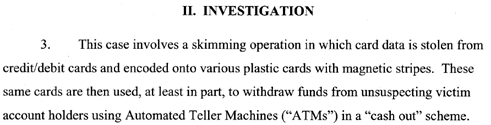
The complaint filed in the U.S. District Court in the Western District of Washington, summarized the scheme this way:

According to government investigators, Trelha was “skimming roughly 100 accounts per day” from a single ATM and described this is a sophisticated operation that they believed was “the tip of an iceberg of fraud…” The investigators noted that Trelha traveled from Florida to Washington to commit these offenses and was sending stolen credit card data overseas to associates. Trelha was convicted in 2017 and served time in prison.


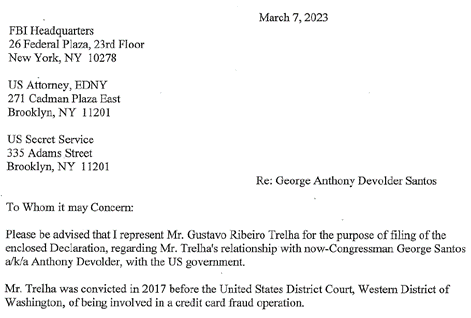
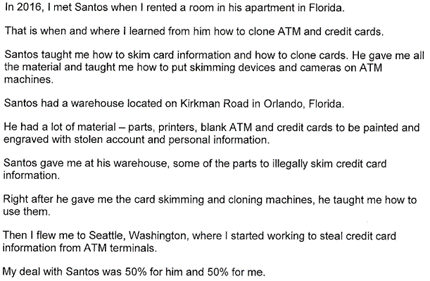
In March 2023, through his attorney, Trelha sent a declaration to the U.S. Secret Service, Federal Bureau of Investigation (FBI), and the U.S. Attorney’s Office in the Eastern District of New York, claiming that George Santos was the one who originally taught him how to engage in credit card skimming in Florida. Excerpts of Mr. Trelha’s attorney’s letter and Mr. Trelha’s declaration are posted below:

Mr. Trelha’s declaration said, in part:

Santos’ congressional office did not respond to questions about his relationship with Mr. Trelha or provide any comment in response to emailed questions about the other allegations and questions about the origins of his finances raised above.

 Campaign Donations

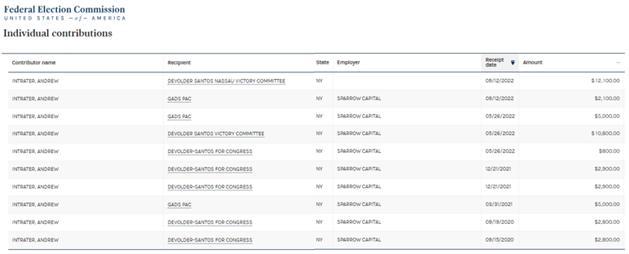
A much more detailed review of George Santos’ donors could have been conducted long before the media first began to call attention to this issue, based on publicly available FEC data. Three weeks after the November 2022 election, the Daily Beast first reported that George Santos received financial backing from Andrew Intrater, an investment banker who runs Sparrow Capital in New York and is a cousin of Russian billionaire Viktor Vekselberg. A review of FEC data shows Intrater contributed a total of more than $47,000 to both Santos’ 2020 and 2022 election bids, including to the George Anthony Devolder Santos (GADS) Political Action Committee (PAC). Intrater first made two separate donations to the Santos campaign in September 2020, more than two years before these donations were first reported by the media.

Intrater, is an American citizen born in New York. His cousin, Russian billionaire Viktor Vekselberg, is close to the Kremlin. In 1990, Vekselberg founded the Renova Group, a conglomerate with interests that include the oil, gas, and telecommunications industry. In 2018 and 2022, the U.S. imposed sanctions on Vekselberg and other Russian nationals in the aftermath of Russia’s annexation of Crimea and its brutal attacks on Ukraine.

According to CNN, Intrater’s attorney, Richard D. Owens, said in a statement that Andrew Intrater is listed as “Contributor #2” in the DOJ indictment against Santos, which alleges that Santos falsely assured “Contributor #2” that his donations would be spent on TV advertisements for his campaign. In fact, at least some of these donations were transferred to Santos’ personal bank accounts, according to the indictment. In his statement to CNN, Intrater’s attorney, said: “Andy is gratified that Santos will now have to answer in court for the many lies George told to Andy and so many other Americans.”

Earlier this year, Intrater also reportedly told the New York Times that George Santos had convinced him to invest more than $600,000 in Harbor City Capital Corp. while Santos was employed at the firm and before the SEC filed its enforcement action against the company.  Intrater told the New York Times that he discovered later that he had been misled by Santos. Mr. Intrater’s attornery did not respond to a request for comment regarding these issues.

Family Funds

Last month, new details were revealed when a judge in New York forced the public release of the names of the individuals who paid Santos’ $500,000 bond for release in May 2023 after he was arrested due to the 13-count criminal indictment filed against him. Santos’ father, Gercino Dos Santos who lives in New York, and his aunt, Elma Santos Preven, were said to have paid his $500,000 bond. However, public records indicate that neither appears to have many assets. His father appears to own no property in New York and Santos’ aunt appears to own one property in New York, a co-op she purchased from another family member in 2006 for $170,000 in Jackson Heights, Queens – circumstances that add to other mysteries surrounding Santos’s financial wherewithal.

More Investigations Underway

 Investigations are still underway by the New York Attorney General’s Office and the Nassau County District Attorney. In addition, the bipartisan House Ethics Committee recently announced that it was expanding its inquiry into Santos to include allegations that he “fraudulently obtained unemployment insurance benefits.” The committee also revealed that it has issued more than 30 subpoenas and more than 40 voluntary requests for information.

Although the records identified above were focused on George Santos, diligent research using records related to individuals, corporate officers, companies, or other entities can yield huge dividends. Conducting a comprehensive sweep of public records helps to identify red flags, ferret out blind spots, and highlight potential trouble spots before they spark scandals that can impact your political or financial bottom-line.

The Santos saga has proven to be a sterling example of how obvious cues should have been followed up, before – and not after – George Santos was hired into his office by voters in the November 2022 elections.

The Santos Scandal: A Deep Dive into Deception (Part 2)

The Santos Scandal: A Deep Dive into Deception (Part 2)

The first post in this series [The Santos Scandal: A Deep Dive into Deception (Part 1)] detailed evident false statements by George Santos about his employment history and education, as well as problematic information regarding his financial assets in 2022 and odd patterns in his congressional campaign’s financial accounting. This post will examine how public records have revealed the questionable corporate ties Santos had while running for Congress.

The Company We Keep

Financial regulatory records at the state and federal level also waved a further series of red flags for anyone that might have looked. In January 2020, Santos joined Harbor City Capital Corp. as a Regional Director in New York. Harbor City’s CEO Jonathan Maroney welcomed Santos in a press release. “I’ve known Mr. Devolder for several years professionally and have always had a lot of respect for how he conducts himself in business,” he said. “When we had the opportunity to welcome him to our team I was delighted. He’s a perfect fit.” The press release included erroneous information from Santos about his previous employment at Goldman Sachs and CitiGroup. Santos also listed his new position at Harbor City Capital on his Twitter account.

Harbor City Capital Corp. described itself as “an alternative investment manager specializing in the implementation of time-tested, proven arbitrage strategies to generate reliable yield from the high growth +$200B Internet advertising sector.” The company made exuberant claims of high yields on individuals’ investments.

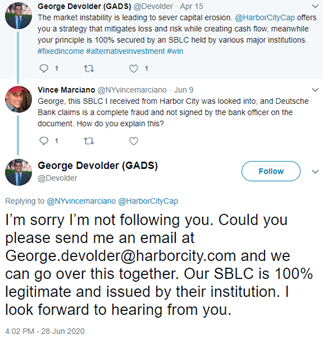
Santos also touted claims of zero risk investments and hefty returns for those that invested in Harbor City Capital Corp. claiming an individual’s principle would be “100% secured” by a Standby Letter of Credit (SBLC) held by major institutions. However, by early June 2020, some cracks in this visage were becoming publicly evident:

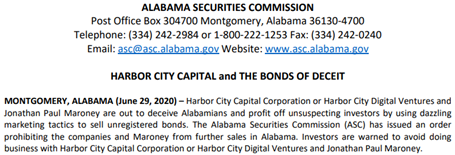
Regulatory scrutiny soon followed. On June 25, 2020, the Alabama Securities Commission issued a “cease and desist order prohibiting” Harbor City Capital Corp. and its CEO Jonathan Maroney “from offering or selling securities in the state.” The commission found that Maroney and his affiliated companies were offering 18% annual returns on investments and the commission found that they “caused unrealistic claims of investment performance and unrealistic predictions of market profitability to be displayed on their web site in order to induce investors to purchase their securities in violation” of the law. The Alabama Securities Commission did not mince words in its press release regarding its cease-and-desist order against Harbor City Capital Corp.:

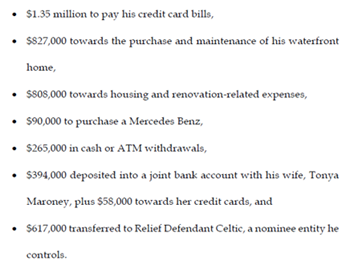
On April 19, 2021, the Securities and Exchange Commission (SEC) pursued its own actions against the company, filing an “emergency action to stop an ongoing, fraudulent Ponzi-scheme victimizing hundreds of investors across the United States” that was being perpetrated by Harbor City Capital Corp., its related entities, and its CEO Johnathan Maroney. The SEC alleged that starting in May 2015, or before, Maroney and the entities he controlled raised more than $17 million “through a series of unregistered fraudulent securities offerings….” and that “Maroney used investor money to enrich himself and his family, and to perpetuate the Ponzi scheme by making payments of fictitious returns to existing investors using other investor funds.” He used part of the money to buy a Mercedes Benz, a waterfront home, and to pay more than $1 million in credit card bills, according to the SEC filing:

In April 2021, the same month the SEC issued its enforcement action against Harbor City Capital Corp., George Santos left the company. He has not been implicated in the Harbor City Capital Corp. case. Maroney was the only individual named in both the Alabama and the SEC suits.

Ties That Bind

Tracking corporate filings can provide critical insight into both business entities and individuals, as well as a window into who they have chosen as business associates. Several of the individuals that worked at Harbor City Capital quickly moved on after the SEC’s April 19, 2021, enforcement action to start their own companies. In 2019 Jesse McMinn was hired as a videographer at Harbor City Capital Corp. Fifteen days after the SEC’s action, he incorporated Red Strategies Video Inc. in Florida as its President. Paul Nicolini – the Regional Director of the Investment Professionals Divion at Harbor City Capital Corp.–incorporated Paul Nicolini and Associates Inc. on the same day. Red Strategies LLC, USA was also established at the same time.

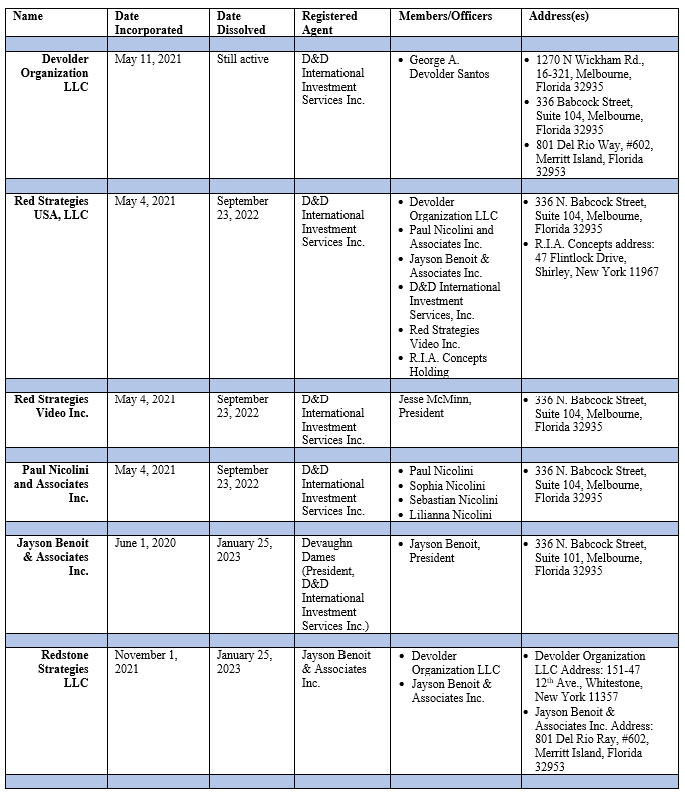
On May 11, 2021, six days after these three companies were incorporated, George Santos established Devolder Organization LLC., a group that Florida Secretary of State records show was linked to five companies established by Harbor City Capital Corporation personnel. Three were established 15 days after the SEC filed suit against Harbor City Capitol Corp., and all three were administratively dissolved for failing to file their annual financial reports on the very same

day in late September 2022, two weeks after Santos filed his second financial disclosure report with Congress. Two of the other companies were voluntarily dissolved on January 25, 2023, after the New York Times published its initial investigative story on Santos. (The Devolder Organization also appears to have failed to file its annual financial report at the beginning of 2022 and became inactive in Florida. However, on December 20, 2022, it filed paperwork and was reinstated by the Florida Secretary of State’s office. It is currently the only entity out of the five other companies listed below that still has an ‘active’ status, according to Florida Secretary of State records.)

Connect the Dots

Santos kept company with interesting characters. The Redstone Strategies annual report filed in Florida on January 14, 2022, listed George Santos, Paul Nicolini, Jayson Benoit, Jessee McMinn, and Devaughn Dames as officers, all of whom worked at Harbor City Capital Corp. but none of whom were specifically named in the SEC’s enforcement actions against the company and its CEO Jonathan Maroney.

In addition, one of the corporate officers of Red Strategies USA, LLC, R.I.A. Concepts Holding, provided its address as 47 Flintlock Drive, Shirley, New York 11967. That address is the home of Nancy Marks, who worked as a treasurer for both Santos’ 2020 and 2022 congressional campaigns.

Interestingly, the Devolder organization was registered in 2021 by a claimed financial consultant named DeVaughn Dames, who served as a treasurer for another Republican candidate in 2022 Tina Forte (she lost). During the 2022 election cycle Tina Forte’s campaign made 77 separate payments to Red Strategies USA, for a total of $110,320.05 under the rubric of “Digital Consulting and Fundraising” services. Red Strategies included Santos’ Devolder Organization LLC, and others associated with Harbor City Capital Corp., as corporate officers.

In August 2019, Dames became the Chief Financial Officer at Harbor City Capital. Through his own company, D&D International Investment Services Inc., he ended up becoming the registered agent for five of the six companies cited above.

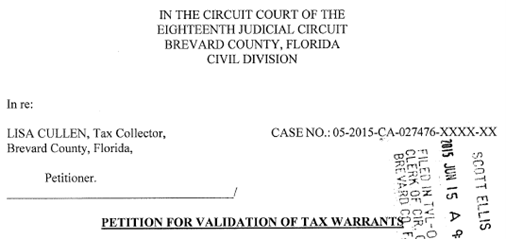
In 2015, D&D International Investment Services Inc. and Devaugh Dames were cited in a court case initiated by the Brevard County Tax Collector in Florida for owing nearly $3,000 in back taxes. Those taxes appear to have been repaid by July 2015.


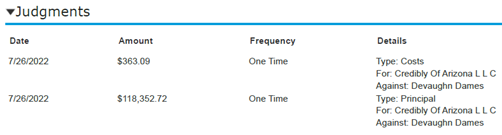
Last year, in July 2022, Credibly of Arizona LLC, a retail capital company, won two separate judgements in a lawsuit it filed against Devaughn Dames in the amount of $118,352.72 and $363.09 in a case that was brought in Arizona’s Maricopa County Superior Court.

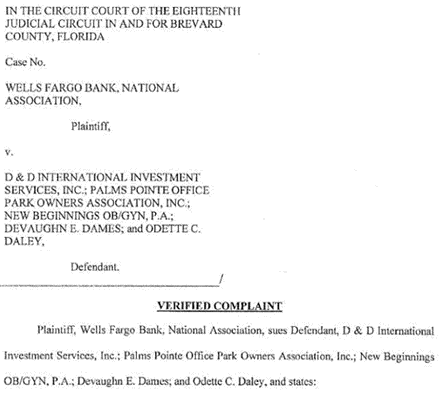
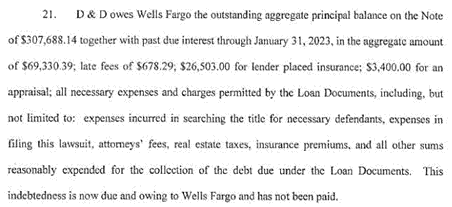
More recently, in March 2023, Wells Fargo sued Devaughn Dames’ company D&D International Investment Services, Inc. for debt recovery to “foreclose a mortgage on real property” regarding its offices at 336 N. Babcock Street in Melbourne, Florida. This is the address provided for five of the six companies listed above. In 2009, Wachovia issued the original Note to D&D International Investment Services for nearly $1.2 million, but it was taken over by Wells Fargo when the two companies merged. Wells Fargo alleges in the suit that D&D has been delinquent on its payments and owes it a total of more than $400,000.

On May 23, 2023, the Eighteenth Judicial Circuit Court for Brevard County, Florida set a trial date of March 22, 2024, for this case.

Pulling business records, identifying corporate addresses, and compiling court cases can often help weave together a collage of the friends, colleagues, and business associates of the individual you are investigating. Our previous post revealed red flags about Santos’ claimed employment, education, and finances. Our third and final post will highlight his previous brushes with the law and unresolved questions about the origin of his finances. Taken together, this information can help paint a clearer picture of the individual’s character and potential avenues to pursue further.

The Santos Scandal: A Deep Dive into Deception (Part 1)

The Santos Scandal:  A Deep Dive into Deception (Part 1)

The congressional candidate’s website said he briefly attended an elite private school in the Bronx, New York. His campaign literature said he worked at Goldman Sachs and Citigroup. In a required financial disclosure form filed five months before his failed 2020 election attempt, he claimed his earned income in 2019 consisted of a $55,000 salary. It listed no assets, bank or checking accounts, investments, or properties. Somehow, however, according to his filings with the Federal Election Commission (FEC), he loaned his campaign $23,850 in 2019 and an additional $57,400 in early 2020.

The following year, in April 2021, a company he started working at in January 2020 was hit by the Securities and Exchange Commission (SEC) with an “emergency action to stop an ongoing, fraudulent Ponzi-scheme victimizing hundreds of investors across the United States.” By 2022, according to a Congressional filing related to his second election bid, his financial wellbeing had nonetheless improved tremendously. His annual salary had risen to $750,000, and his “unearned” income leapt to between $1 million and $5 million for that year, while his assets had skyrocketed to between $2.6 million and $11.3 million.

George Anthony Devolder Santos (“George Santos”) is now well known, and the target of a 13-count criminal indictment by the Department of Justice that includes seven counts of wire fraud, three counts of money laundering, one count of theft of public funds, and two counts of making materially false statements to the U.S. House of Representatives. He has pleaded not guilty. However, his past appears to be catching up with him.

It should have happened much sooner. The falsehoods, distortions, and trail of misconduct surrounding Santos should have resulted in an avalanche of scrutiny well before it did. While a glimmer of the troubles surfaced in the local Long Island, New York, newspaper, the North Shore Leader two months before the 2022 election, the gravity and scale of his falsehoods did not come to light until one month after the election, when the New York Times published a detailed account of his fabrications. In short, the press, both main political parties, and public officials all failed to conduct a proper due diligence probe of him before the November 2022 election.

The George Santos saga thus provides a valuable lesson not only for politics but for investigative practices – and in particular, how public records can help reveal red flags. This is the first of three posts to be published in the coming days that will detail how such a review would have been able to unmask the mirage Santos projected before the November 2022 elections. Scrutinizing available public records would have revealed:

  • Falsehoods in Santos’ public educational claims, by checking his educational record;
  • Fabrications in his stated professional experience, through a review of public sources;
  • Serious questions about the origin of the more than $700,000 he personally loaned his own campaign in both the 2020 and 2022 election cycle, based on FEC records;
  • Questions regarding his unexplained sudden personal financial success in 2022, based on Congressional financial disclosure documents;
  • Clear connections between Santos and multiple individuals who started companies in Florida days after the SEC’s “emergency action” against his former employer.

Part 1: A Litany of Lies

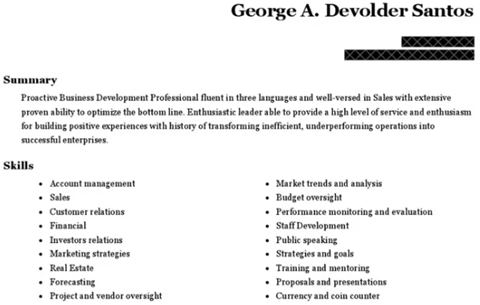
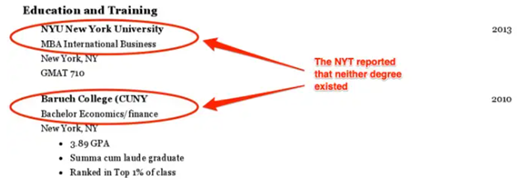
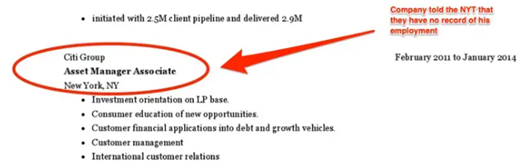
George Santos announced his first run for Congress in November 2019, as a Republican candidate. He lost the election to Thomas Suozzi the Democratic incumbent of New York’s 3rd congressional district, but he ran again in the 2022 election cycle. From the very start, his campaign website listed distortions and fabrications that could have been quickly and easily verified to be false.

An annotated version of his resume, first released by the New York Times, was published by Business Insider, and is provided below.

Whether you are vetting a potential employee, senior executive, or attempting to learn more about a competitor or political candidate, resumes are a critical starting point for an investigation. Vetting claims can help to identify exaggerations, outright falsehoods, and character issues that provide key insights and future paths for further analysis.

Financial Flimflam

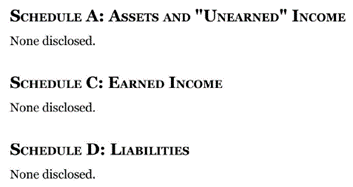
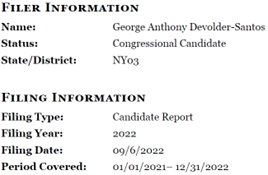
Records that show an implausible personal trajectory are among the most obvious red flags. On May 11, 2020, for example, Santos filed a required financial disclosure report to the House Committee on Ethics. Under the “Earned Income” section, he indicated that his salary, commission, and bonus at LinkBridge Investors in 2019 was $55,000.

Although required to be fully disclosed, under “Assets and “Unearned” Income,” “Earned Income” and “Liabilities,” he wrote: “None disclosed.”

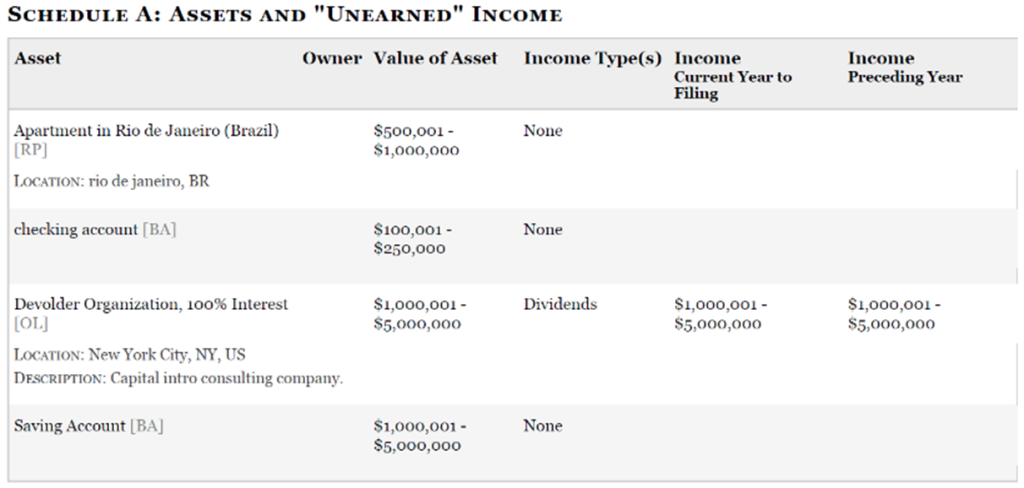
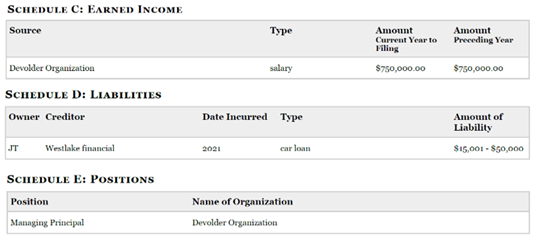
On September 6, 2022, during his second run for Congress, Santos filed his second Congressional financial disclosure report. In the span of a little over two years, Santos claimed he had acquired an apartment in Rio de Janeiro, Brazil worth between $500,000 and $1 million. He accumulated more than $1 million in his savings account and at least $100,000 in his checking account. He incorporated in Florida a New York City-based consulting firm called the Devolder Organization LLC, in which he claimed a 100% interest worth between $1 and $5 million. His annual salary there was $750,000 and his “Unearned” income – based on dividends from the company – was between $1 million and $5 million. He also went from having no declared assets in 2019 – as reported in his May 11, 2020, financial disclosure report – to assets ranging from $2.6 million to $11.3 million in his 2022 financial filing. His financial situation went from meager to materially substantial virtually overnight.

Excerpts from Santos’s financial disclosure report to Congress filed on September 6, 2022, are pasted below.

This sort of unexplained financial bonanza in such a relatively short period of time should have set off investigative alarm bells.

Pay Thyself

Odd personal financial dealings can also signal potential character issues and shortcomings in trustworthiness. According to the FEC, candidates for federal office are permitted to use unlimited amounts of their own “personal funds” for campaign purposes. There are also no limits on “loans” made from candidates’ personal funds to their campaigns. In addition, a candidate may choose to forgive “all or a part of a loan from his or her personal funds to the campaign.” However, a candidate must file a signed statement indicating that he or she forgives the loan.

Santos, according to his FEC disclosures, during his 2020 and 2022 election races personally loaned his campaigns a total of $786,250. Red flags were apparent in these disclosures early on that should have drawn more scrutiny. On March 31, 2020, he personally loaned his campaign $50,000, nearly his entire salary from the previous year. Additional loans for that election totaled $31,250, eclipsing his entire 2019 salary. His personal loans to his campaign during the 2022 campaign increased dramatically to $705,000, nearly matching his claimed salary of $750,000, as reported in his September 2022 financial disclosure report to Congress.

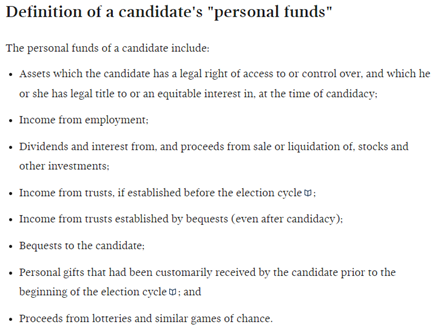
The FEC defines personal funds this way:

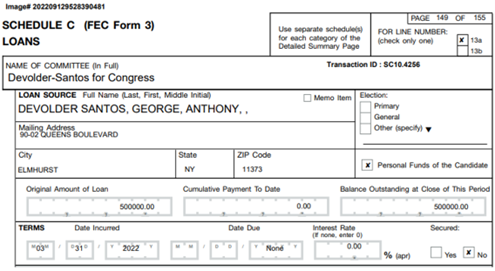
For the $81,250 Santos loaned his campaign during the 2020 election, his campaign repaid him $31,200 in November and December 2020. So far, his campaign has not repaid any of the $705,000 Santos personally loaned his campaign for the 2022 election. An example of the FEC records citing the “personal funds” that George Santos loaned to his campaign is provided below.

A $199.99 (Miraculous) Coincidence

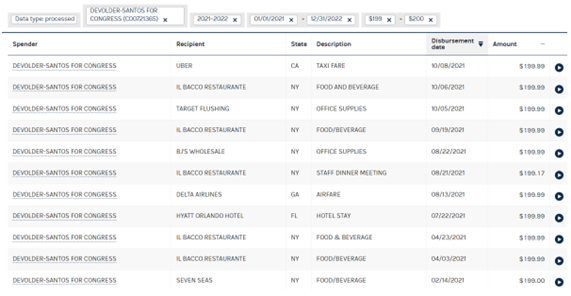
Sometimes records speak volumes through their omission of details or simply their unlikely veracity. According to records filed with the FEC between January 1, 2021, and December 31, 2022, the Devolder-Santos for Congress campaign listed 37 separate expenses for exactly $199.99, without any reasonable accounting. These purchases included an office supply run to Staples on December 27, 2021, and also on the following day. Each purchase totaled $199.99.

Two separate shopping trips to BJ’s Wholesale two months apart in August and October 2021 cost exactly $199.99, as did three trips to Best Buy over a four-month period.

Despite the fact that the price of airline tickets frequently fluctuates due to gas prices and other factors, four separate flights on Delta Airlines from August to December 2021 each cost the Santos campaign exactly $199.99. From October to December 2021, the campaign reported five separate Uber rides, all in California, that each cost exactly $199.99. Miraculously, Santos campaign officials also appear to have ordered the same items from the menu when they frequented the Il Bacco Restaurant on Northern Blvd. in Little Neck, Queens, in Santos’ congressional district seven times, with each visit producing an expenditure of precisely $199.99.

As Politico reported in January 2023:

Campaigns rack up millions of dollars in expenses and thousands of line items per campaign, but it is rare for them to notch even one $199 expense, according to a POLITICO review of campaign finance records. FEC data shows more than 90 percent of House and Senate campaign committees around the country did not report a single transaction valued between $199 and $199.99 during the 2022 election cycle.

Santos reported 40 of them.

In fact, his campaign accounted for roughly half of all expenses by all campaigns that cost exactly $199.99 — a statistical improbability.

In listing these amounts, Santos evaded the FEC’s requirement regarding documentation for these expenses because they fell under $200 by a single penny, as outlined here:

A sampling of the $199.99 expenses reportedly incurred by the Santos campaign that they reported to the FEC are provided below.

This is the first of three posts examining how a diligent review of public records could have shed light on questionable behavior by George Santos and raised serious questions about his veracity before the November 2022 election.

Exposing Secrets: 6 Forensic Techniques to Decrypt the Teixeira Leak

Exposing Secrets: 6 Forensic Techniques to Decrypt the Teixeira Leak

The leak of classified documents by Jack Teixeira, an airman first class of the Massachusetts Air National Guard, has sent shockwaves through the intelligence community. While Teixeira has been identified and arrested, the investigation is far from over. This article delves into six forensic investigation techniques that will be used by federal investigators to reconstruct the events surrounding the leak and secure vital information in his prosecution, all of which are used everyday by my team at RosettiStarr in investigations we conduct every day.

1. Digital Forensic Evidence: Tracing the Electronic Footprints

Digital evidence plays a crucial role in most modern forensic investigations. Investigators will be analyzing Teixeira’s electronic devices, including his computer, smartphone, and any external storage devices, to find traces of leaked documents and communications with others. These digital footprints can reveal valuable insights into his motivations, accomplices, and the scope of the breach.

The advanced digital forensics tools and techniques that can be used include file carving (a forensics technique used to extract a formatted file or data from a disk drive or other storage device without the assistance of the filesystem that originally created the file), analyzing metadata, and tracing IP addresses. In the case of Teixeira, investigators may use these techniques to recover any deleted files or communications that could point to accomplices, motives, or methods. They will also analyze his browsing history, email records, and messaging apps to determine if he was in contact with any foreign entities or other individuals who may have encouraged or facilitated the leak.

2. Public Record Evidence: Building the Profile of the Suspect

Public records can provide extremely valuable retrospective information in forensic investigations. To better understand Teixeira’s potential motives and connections, investigators will turn to public records to build a comprehensive profile of the suspect.

Investigators will be pouring over his employment and military service records, court documents, and any previous criminal history. These records can shed light on his background, qualifications, and any potential red flags that may have been overlooked during his security clearance process.

Additionally, they can scrutinize online public records, such as social media accounts, to understand his social circles and potential accomplices, sometimes with the assistance of a subpoena. For instance, they may examine his open internet comments and accounts, but also non-public information such as connections and direct messages on platforms like Discord where the leaks initially occurred, as well as Facebook, Twitter, YouTube, Telegram and others. Those links will enable them to identify individuals who may have had access to the leaked documents or who may have encouraged Teixeira to carry out the leak. Public records pertaining to personal assets can also help identify any financial irregularities that may be linked to the leak, like unexplained wealth or transactions, although he was living with his parents and does not obviously have unexplained wealth. You never know for sure until every stone is turned over.

3. Documentary Evidence: Uncovering Timelines and Hidden Connections

Investigators are likely to examine a host of documents and records to gain more insights into the case. First and foremost, will be the leaked documents themselves. While retyped documents pose more of a challenge than images posted of printouts or images of digital records, analyzing their contents, and comparing them with the authentic versions can help establish timelines based on cached version histories. If the contents have been altered or changed over time, this can help expose any political or ideological motivations. Access logs to classified files can help identify other conspirators or sources of leaks.

There are also private records in the custody of Teixeira and other third parties likely to be examined. While there has been no obvious malign international involvement, Teixeira’s personal correspondence, financial statements, and any other personal documents that may shed light on his activities and linkups leading up to the leak.

His bank statements and credit card transactions will be checked for unusual spending patterns or financial connections to foreign entities. Any personal journals or diaries may contain information about his thoughts, plans, or motives. Encrypted messaging apps and other private communications will be checked for discussions related to the leak or potential accomplices, although their content will likely have to be subpoenaed.

4. Open-Source Intelligence: Gathering Information from Publicly Available Sources

Open-source intelligence (OSINT) is the collection and analysis of publicly available information from sources on the open, dark, and deep web, such as websites, social media platforms, and online forums. Investigators in the Teixeira case have already utilized OSINT to track down the initial source of the leak. However, there is still a wealth of information to be explored.

By monitoring online platforms, such as Twitter, Telegram, and 4chan, where the leaked documents were shared, investigators can identify potential accomplices, gauge public sentiment, and uncover new leads. They can also use advanced web scraping tools and machine learning algorithms to sift through vast amounts of online data, searching for patterns or connections that may be relevant to the case. This can include monitoring unique hashtags, keywords, or user accounts (including fake accounts or those used in botnets for other known foreign government or private operations) associated with the leaked documents or individuals involved in the case.

Additionally, investigators may examine the online activities of Teixeira and his connections to see if any indications of the leak were missed early on. By analyzing their social media posts, online interactions, and digital footprints, the investigators can gain a better understanding of the dynamics and relationships that may have played a role in the leak.

5. Observational Evidence: Examining the Physical Environment

Observational evidence, such as surveillance footage and eyewitness accounts, can provide vital context and corroborate other forms of evidence in a forensic investigation. In the Teixeira case, investigators may review security camera footage from his home, the SCIF (a sensitive compartmented information facility where trusted personnel work with classified material) where he worked or accessed the leaked documents, or other locations he frequented. This can help them build a detailed timeline of events leading up to the leak, identify any suspicious activities, or even spot potential accomplices.

6. Eye-Witness and Expert Testimony: Gathering Firsthand Accounts and Expert Conclusions

Eyewitness testimony from those who interacted with Teixeira before and during the leak can offer valuable insights into his motives, actions, and associations. These firsthand accounts can help paint a more complete picture of his character and behavior, potentially revealing warning signs or patterns that went unnoticed.

They will surely interview family, friends, and coworkers in his National Guard unit to gather additional information about his behavior, state of mind, and potential accomplices. These interviews can reveal personal relationships, conflicts, or other behavior that may have contributed to the leak. Moreover, they may provide crucial corroborating evidence to support digital and documentary evidence. Expert testimony can also explain the authenticity, accuracy, and potential impact of the leaked information.

Challenges and Future Directions

As the investigation continues, several challenges may arise. The sheer volume of digital evidence, including social media posts, online communications, and leaked documents, can be overwhelming for investigators to sift through. Advanced analytics tools and machine learning techniques used in voluminous document reviews can help streamline this process, but the sheer scale of the data remains a challenge.

Another potential issue is the international nature of the case. The leaked documents have implications for multiple countries, which can create jurisdictional challenges and complicate the investigation if others are involved. Cooperation between international law enforcement agencies and intelligence organizations will be critical to overcome these obstacles and ensure a thorough and effective investigation.

Investors Should Have Seen FTX Coming

Investors Should Have Seen FTX Coming

COMMENTARY

By R. Jeffrey Smith

Managing Director, RosettiStarr LLC

(A version of this article was published on March 26, 2023 in Barron’s.)

Everything looked ideal, until it didn’t. A supposed whiz kid with MIT branding who had made a small fortune in currency-price arbitrage invited investors to make much larger fortunes, using a special trading sauce whipped up for a hot new financial arena. He set up a workplace offshore—but wasn’t everyone working remotely anyway? He had a cherub’s face, an earnest demeanor, and an impressive family pedigree.

Sam Bankman-Fried even looked the tech-guru part, dressing in classic sweats and cultivating a reputation for long office hours and ascetic living. He claimed, moreover, to be earning huge sums of money mostly to help others and make the world a better place. He spoke inspirationally about how his trading company would soon become accepted as a repository of savings and a venue for low-cost transactions. Its revenues were reported to have jumped from $90 million in 2020 to more than a billion dollars in 2021.

Bankman-Fried’s firms—FTX and Alameda Research—imploded spectacularly after a nine-day downward spiral in November that wiped out billions of investors’ dollars, led to his arrest, and forced him to surrender control. Bankman-Fried has pleaded not guilty, and the courts will decide his liability. But as far as investors are concerned, the FTX saga is hardly the first time investment assets have evaporated on this scale amid plentiful signals that mischief was afoot, a lesson that hasn’t fully sunk in and could easily be missed again.

Bernie Madoff’s Ponzi scheme defrauded thousands of investors out of tens of billions until he was arrested in 2008. Bankman-Fried’s operation echoes one set up 17 years earlier by a Texan named Allen Stanford, who set up trading operations on an island, hired his former college roommate as an executive, arranged off-books loans from his firm, and went on to fleece thousands of investors out of roughly $7 billion, some of which he spent on real estate and other lavish perks. Stanford was convicted in 2012 of defrauding customers and sentenced to 110 years in prison.

Watching another big scandal unfold—followed by congressional investigations amid hand-wringing about regulatory distraction—prompts fresh wonder about whether the financial system is so rickety and reliable corporate data so spare that ambitious investors are simply doomed to periodically lose their shirts. Investors looking at recent crypto losses have reason to ask whether the FTX fiasco could have been foreseen, and whether the problems that are now dogging Bankman-Fried are lurking elsewhere.

A third of the members of Congress—who recent tallies indicate took in roughly $93 million in political donations from FTX employees over the past two election cycles, funds they were asked to return by the end of February—clearly did not ask those tough questions. But a close look at FTX’s history makes clear there were red flags that could have sowed alarm for potential investors, regulators, and politicians, if only they’d conducted a serious research effort and paid attention to the results.

To start with the basics, Bankman-Fried was candid long before his indictment about his weak preparation for creating Alameda at the age of 25. His undergraduate degree was in physics. He wrote on Twitter in August 2020 that he’d had trouble in school and “spent most of my life learning to be ok-but-not-very-good” at online gaming. At FTX, he was well-known, in fact, for gaming during business meetings, including during a digital February 2022 appearance at the Economic Club of New York. His habit abetted his reputation as an oddball savant but should have been seen instead as a signpost of inattentiveness to fundamentals—an impactful shortcoming for someone forging a new path in an unregulated economic sector.

Bankman-Fried admitted in the same 2020 Twitter thread that a year after founding Alameda the company was beset by internal conflicts, producing “some really shitty times. A management dispute I didn’t know how to resolve boiled over and a bunch of employees left in early 2018.” One of those who left was Tara Mac Aulay, an Alameda co-founder who said in a November Tweet that the resignations were “in part due to concerns over risk management and business ethics.” In all, at least sixty-six FTX employees left the company before September 2022 and posted resumes on LinkedIn, creating a reservoir of information about the firm that potential investors could have exploited.

The staff that remained at FTX and Alameda after these departures was noticeably young and inexperienced. As an April 9 report to the bankruptcy court by FTX debtors noted, they had no previous exposure to “risk management or running a business, [yet] controlled nearly every significant aspect of the FTX Group.” The ambience was more like that of a college fraternity than a multi-billion-dollar business. Company expenses were approved by emojis in a Slack channel. FTX’s head of engineering, Nishad Singh, was a high school friend of Bankman-Fried’s younger brother, and Singh’s girlfriend was the FTX human resources chief; Singh took out a $543 million loan from Alameda, according to court filings. Singh has pleaded guilty to multiple criminal charges.

In 2021, the first year that FTX pulled in more than $1 billion in revenue, FTX and Alameda co-founder Caroline Ellison, 28, tweeted that there is “nothing like regular amphetamine use to make you appreciate how dumb a lot of normal, non-medicated human experience is.” Alameda, which she ran, persistently lost money during its brief existence, accounting for its eventually fatal dependence on FTX bailouts. None of this should have been a surprise. “We tend not to have things like stop losses,” she said in a podcast in May 2022. Stop losses are tools to manage trading risk. In a private, internal communication, Bankman-Fried called Alameda “unauaditable” due to the absence of reliable transaction records, a circumstance he actually described as hilarious.

When speaking in a Jan. 2022 conversation with George Mason University economics professor Tyler Cowen published as a podcast two months later, Bankman-Fried also made clear that his personal tolerance for risk was extraordinarily high. But journalists as well as analysts ignored that flash of dangerous candor, and Sequoia Capital – a firm with $85 billion under management – in September published an article by a contract business writer that called Bankman-Fried “instantly lovable” and a “trader’s trader”; it also extolled his “daring feat of arbitrage” at the outset of his career and his accumulation of “more wealth in a shorter period of time than anyone else, ever.” Neither the author of that article nor the head of digital asset research at Forbes Magazine, which celebratorily featured Bankman-Fried on its Oct. 2021 cover, noted – as the debtors report eventually did – that the FTX head was functioning throughout this period in a vacuum of “independent or experienced finance, accounting, human resources, information security, or cybersecurity personnel or leadership.”

What besides radiant PR fumes gave FTX such impressive sales? It turns out that its marketing sometimes followed a notorious boiler-room model, a circumstance that escaped wide notice because no one appears to have talked to its customers. After the implosion, the New York Times revealed that when Bankman-Fried circulated specific investment opportunities to regular clients, he attached 24-hour deadlines to qualify for the best prices. As one investor told the newspaper, the terms of the offers seemed like “code for saying ‘no diligence.’”

No prescandal review appears to have rigorously compared Bankman-Fried’s public claims of personal privation and devotion to philanthropy with his actions. He told a reporter he planned to keep just 1% of his earnings. But the $190 million in total donations made by FTX’s charitable foundation through the end of 2022 were essentially a rounding error (seven tenths of one percent) for someone with a personal fortune—premeltdown—estimated at $26 billion to $32 billion. The gap was another sign that beneath Bankman-Fried’s claim to huge business acumen was a genuine talent for exaggerated self-promotion, a goal he has acknowledged in several postbankruptcy media interviews. A Feb. 8 court document filed in the Bahamas makes clear that FTX spent more on fancy properties and vehicles used by his employees—$257.4 million to be precise—than the FTX foundation funded by Bankman-Fried and his executives spent on philanthropy. Data of this kind is routinely recorded in retrievable public records.

Some of Bankman-Fried’s and FTX’s expenditures were not public, or reported, because his company, like Allen Stanford’s, chose to operate under much lighter disclosure rules than those governing firms in the United States or other industrialized countries. By itself, the offshoring of his work—first in Hong Kong and then in the Bahamas with retained Hong Kong connections—was a waving red flag, signaling that neither regulatory authorities nor the threat of public shame from adverse financial statements imposed real burdens on FTX for most of its existence. The absence of information, as any Sherlock Holmes devotee knows, can be significant. And at the FTX Group, there were, as the company’s bankruptcy trustee John J. Ray III has testified, virtually no “audited or reliable financial statements.”

Not everything alarming about the company was hidden; it was instead largely ignored. FTX’s U.S. branch had transparently bumpy relations with financial regulators, for example, including a clearcut conflict with the government about the company’s trust and credibility. Last August, the Federal Deposit Insurance Corporation publicly ordered FTX U.S. to cease claiming that its products or accounts were federally insured.

The company’s U.S. president Brett Harrison—whose statements were specifically cited by the FDIC complaint—said “we really didn’t mean to mislead anyone.” But the firm’s exaggerated claims could have been read as signposts of an unscrupulous corporate culture and a harbinger of shortfalls in its revenues and profits. In late September 2022, Harrison notably stepped down from his position as U.S. CEO position, claiming four months later that he did so because his “relationship with [SBF]… and his deputies had reached a point of total deterioration, after months of disputes over management practices at FTX.” He also called his former boss insecure, prideful, spiteful, and volatile. That level of dysfunction should certainly have been discoverable.

The FDIC’s letter, moreover, went to FTX’s president and its chief regulatory officer, Dan Friedberg, who had a noticeably blemished employment record. Friedberg had been a counsel to the online poker site UltimateBet in the mid-2000s as it attempted to cap payouts to customers cheated by the firm’s software. Although a recent version of his LinkedIn profile omitted mention of his work for the firm, that omission was itself another problematic signpost.

To recap, then, those bewitched by Bankman-Fried ignored or simply failed to search for evidence of his low qualifications, his team’s inexperience, the alarming qualities of its work habits, the large gaps between his promises and actions, the absence of any leavening executive influences or meaningful independent oversight, and a history of major clashes between Bankman-Fried and staff or regulators. All of this was discoverable before the bankruptcy.

Was FTX’s downfall predictable? You bet it was. And there’s plenty of reason to believe the next big downfall will also be predictable – so long as a careful search is made in advance for the right cues, and the results are heeded.